
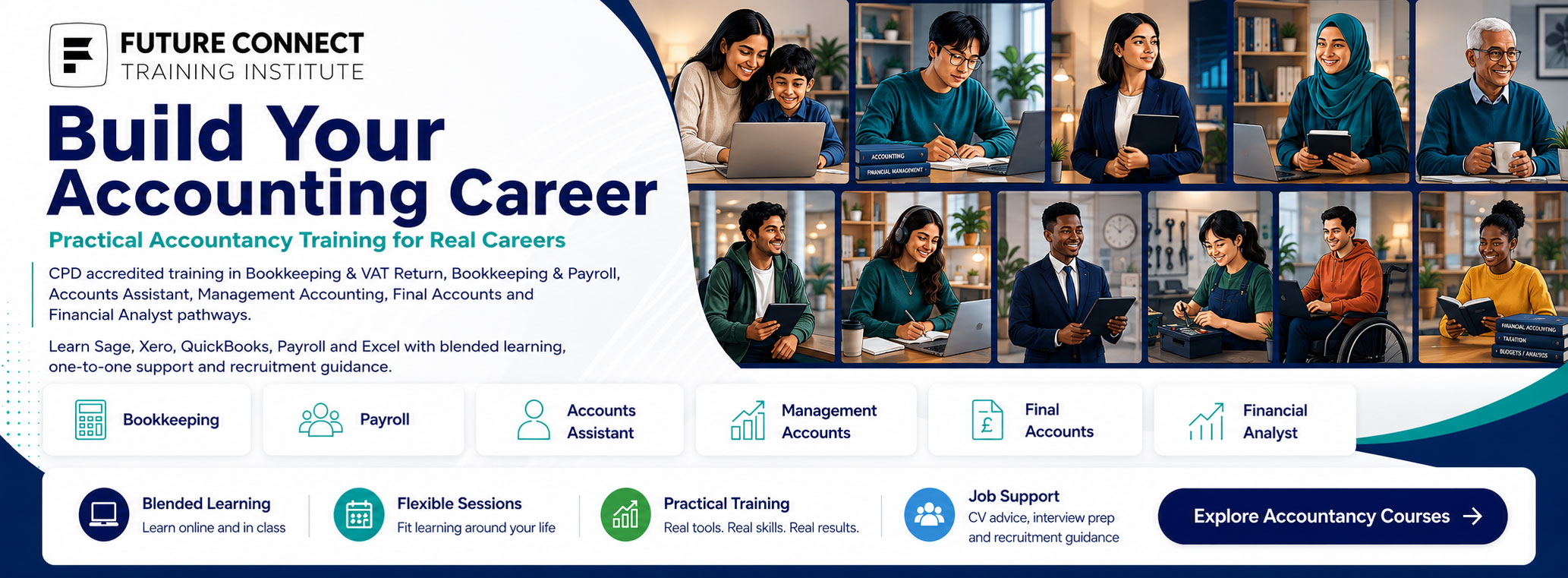
CPD Accredited Practical Accountancy Training
Future Connect offers the broad range of Accountancy Trainings enabling you to enhance your skills and make you more employable.
You would be challenged in form of quizzes, group discussions and mock interview sessions to help build your confidence.
We believe that all our learners should have access to the latest software knowledge and assessablity not only from our centers but from comfort of their home.

- 2-3 Months
- 25 Sessions
- Advanced
- 2-4 Months
- 35 Sessions
- Advanced

- 2-6 Months
- 55 Sessions
- Advanced
- 2-3 Months
- 25 Sessions
- Advanced

- 2-7 Months
- 85 Sessions
- Advanced

- 6-8 Months
- 80 Sessions
- Advanced

- 4-6 Months
- 50 Sessions
- Intermediate

- * Weeks
- * Sessions
- Advanced
Short Accountancy Courses - Tailored for both Corporates and Individuals
At Future Connect, we understand the crucial role of finance and accounting in managing a company's finances, and that's why we offer tailored Corporate Accountancy Courses to meet the unique needs of businesses in private and public sectors, including government and non-profit organizations. Our courses cover a broad range of topics such as Sage, Xero, Quickbooks, payroll, brightpay, Sage payroll, bookkeeping, accounts assistant, management accounts, and final accounts training. We aim to equip you with the knowledge and skills necessary to manage your company's financial operations effectively. Our expert instruction and hands-on training will provide you with the tools you need to drive growth in your business. Don't let financial management hold your business back - enroll in our Corporate Accountancy Courses today and gain the skills you need to succeed.
- 2 Weeks
- 6 Sessions
- Advanced
- 4 Weeks
- 12 Sessions
- Advanced
- 6 Weeks
- 12 Sessions
- Advanced

- 8 Weeks
- 16 Sessions
- Advanced
- 8 Weeks
- 16 Sessions
- Advanced
- 6 Weeks
- 12 Sessions
- Advanced
- 4 Weeks
- 8 Sessions
- Advanced

- 6 Weeks
- 12 Sessions
- Advanced

- 6 Weeks
- 12 Sessions
- Advanced

- 6 Weeks
- 12 Sessions
- Advanced

- 6 Weeks
- 12 Sessions
- Advanced
- 6 Weeks
- 12 Sessions
- Advanced
Short Courses
Accounting Software’s Included
You have option of learning any of the following Accounting Softwares :
Benefits
Blended learning approach with revision based clients accessible from home to give you maximum support in learning.
Flexible one to one training sessions built around your availability, with option to choose days, timing and sessions.
Recruitment company helping you with job hunting after training.
Certification from certified Accounting firm.
Specialised one to one coaching sessions for CV, Interview preparation and Job hunting tips.
Installation of software in your laptops for practice from home.
Covering experience requirement for all major accounting bodies.
Accountancy Job Roles
After completing your accountancy qualification with AAT qualification levels or professional degrees such as CA, ACCA, or short courses, you become eligible for a job. You can work in the bookkeeping and accountancy sector, taxation sector, corporate finance sector, government sector, law and crime sector, or environmental sector.
Your position in the company or institute will be based on your experience, qualification level, and skills. The job positions start from trainee or assistant level to more prestigious director or CEO roles. The jobs available for accountancy qualified professionals are listed below.
Account Manager
Account Assistant
Junior Account Manager
Bookkeeper
Trainee Accountant
Accountancy Manager
Trainee Corporate Finance Assistant
Finance Manager
Audit Expert
Chartered Accountant
Account Payable Clerk
Tax Accountant
VAT Accountant
Trainee Tax Assistant
Forensic Accountant
The scope of Accountancy in UK
Accountancy is a highly disciplined and skilled field and is very demanding in the UK. Research has depicted that the demand of accountants in the UK is expected to increase where 80,000 more fresh and experienced accountants will be recruited by the year 2050. The country has a strong financial position that increases the accountant’s demand in the government sector and within the companies.
Moreover, the salaries of accountants are higher than workers in other sectors such as education. The field offers a stable career over time and improves your life skills along with enhancing your financial condition in the society. Therefore, you must not hesitate to take up an accountancy career as it is still the secure department after the havoc of covid-19.
Worth of account training courses
Accountancy short courses are also in demand and help you to gain more recruitment chances. Accountants having accounting software knowledge and concepts about accounting fields such as audit, VAT, and others help you to get jobs with handsome salaries. You can choose any course from our short courses list to become a more competent accountant.
We give practical Accountancy Training on an extensive list of courses that enhances your accounting skills and make you work environment ready in the fast-paced world of the accounting sector. To help you build your confidence, we have interactive sessions with quizzes, mock interviews and group discussions with brainstorming. Joining our training, our to be professional candidates will have expertise using the latest accounting software's like SAGE, XERO, QuickBooks and building spreadsheets in MS Excel and have efficient knowledge. You can access our training from our centres also from the comfort of your home. Our experienced CPD Certified professionals will coach you throughout the entire learning process.